

By Srishti Bali
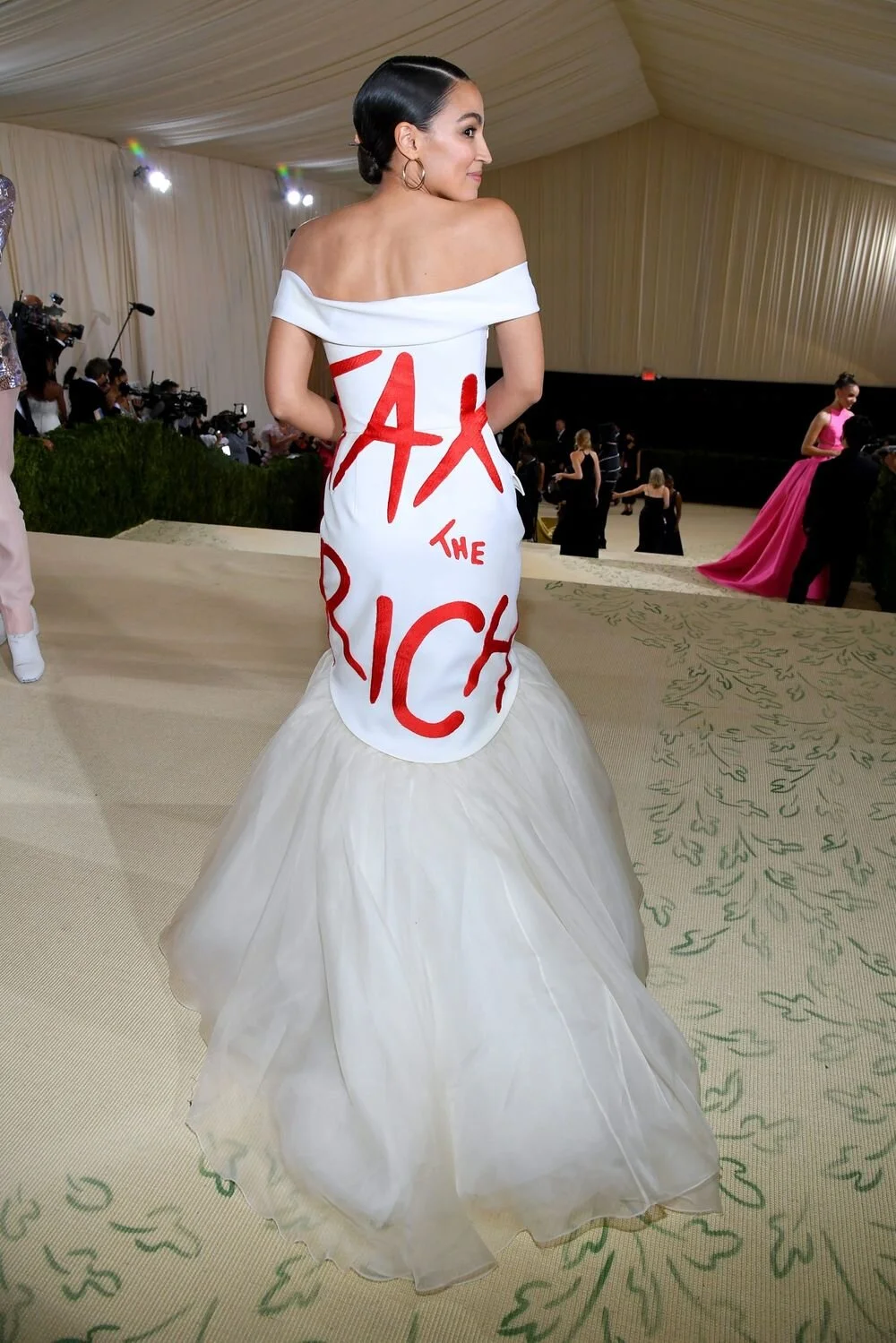
Beyond surface level discourse: The AOC dress.
It is undisputed that AOC’s Met Gala “Tax the Rich” dress has cultivated the surfacing of various perspective on the matter. Namely, the arguments across the matter have looked something like this:
Why did AOC decide to make such statement when the Met Gala tickets are approximately $30,000? Isn’t it ironic that in order to make an anti-capitalist statement she was likely to have spent a considerable amount feeding into the exact thing she was protesting?
Many politicians are invited to the Met Gala without having to contribute the significant amount, therefore as a congresswoman it was the perfect way for her to campaign in a room full of people that are highly likely to lobby against tax and are the “rich”.
Why are we being more critical with AOC when she is a congresswoman who lives up to her values in her political conduct?
Although such arguments are at the forefront of the discussion, they reflect the lack of nuance that is required to dissect whether the dress was effective anti-capitalist messaging. Of course, it is undisputed that the dress itself was made in an ethical way and by a local designer that AOC chose to elevate through a popularised event such as the Met Gala. It is also uncontentious when it comes to the broader dissection of anti-capitalism that the question of whether she paid for the ticket or not is a non-issue. Further, it is also a non-issue that the work she does as a congresswoman is important, effective and impressive. However, what presents as an issue is the broadcasting of an anti-capitalist statement through a medium that reinforces just the opposite.
As anti-capitalist philosophers like Slavoj Zizek would argue, there is always a temptation with American politics to follow a political figure because of the issues to which they subscribe to. Any political message is quite incidental when compared to the formal environment in which it is transmitted. This meaning that we have a falsehood of free choice when we exhibit statements in such environments that are the antithesis of what we want to provocatively express. It therefore does not matter what is expressed in a medium, since what really matters concerns the way in which the medium forms political imaginations or allows violence to flourish. Therefore, such political messaging is adherent very much to a neoliberal approach of “change from within” with is in direct tension with anti-capitalism as per AOC’s message. Thus, trivialising the serious issue that she intends to bring attention to through her messaging in the Met Gala context.
As AOC presents as a popular political figure, not only in America but also around the world, people are well aware of what her politics are and those who engage in it are already convinced or close to being convinced that inequality through our taxation system must be addressed. Through posing messaging to those who are likely to lobby for the opposite in an environment such as the Met Gala, it is highly unlikely that such individuals who have been consistent perpetrators are to be convinced by such political statement as they benefit substantially from income inequality and are unlikely to find a dress persuasive to retract the benefit they acquire. These individuals are also well aware that AOC is fundamentally against any advances they wish to make to avoid being taxed and therefore are likely to dismiss any potential effect the “Tax the Rich” dress may have on them. Hence, we should query whether it is an effective exercise in the first instance regardless of intention as those that need convincing are highly likely not to be convinced.
Historically, The Met Gala is where wealthy, popularised figures go to make empty statements. No one at the event is actively rebelling against the power structure, which is contrary to AOC’s conduct as someone who is consistently rebelling in her usual conduct as congresswoman. As a figure who is recognised for her strong beliefs, by participating in the Met Gala with its historic context of performative progressivism by those who are fundamentally capitalists presents an unusual action on her behalf. Although she is clearly contrasted as her everyday conduct does not negatively prevail her politicised expression, by willingly participating in an environment where that is the contrary, she allows her conduct to be tainted as part of the masses.
When evaluating these broader socio-political consequences, it can be concluded that the “Tax the Rich” dress is provocative in the Met Gala context because it may be bolder than the norm and by someone who is not performative in their everyday conduct. But, the truth is that any policy change cannot be incited if the political messaging is not going to convince the people that need convincing.
Although AOC is a tenacious political figure that many of us look to, it is important that we do not just take things that figures we look up to do as fantastic all the time and critically think about it. Critically thinking does not mean we stop looking up to them or start to dislike them. In this instance, it is not a critique of AOC as a figure but what the conduct embodies when critically engaging in anti-capitalist discourse in a contemporary environment. It is difficult to execute effective anti-capitalist messaging and the “Tax the Rich” dress presents exactly that: the tension of effectively broadcasting change to accumulate political traction without trivialising the issue.
Therefore, when engaging in discourse we must do so in a critical way otherwise we are doing the discourse injustice. We must move beyond criticising the individual and evaluate the conduct in the purpose it wishes to achieve and gauge it in the way and in the environment it is performed.